
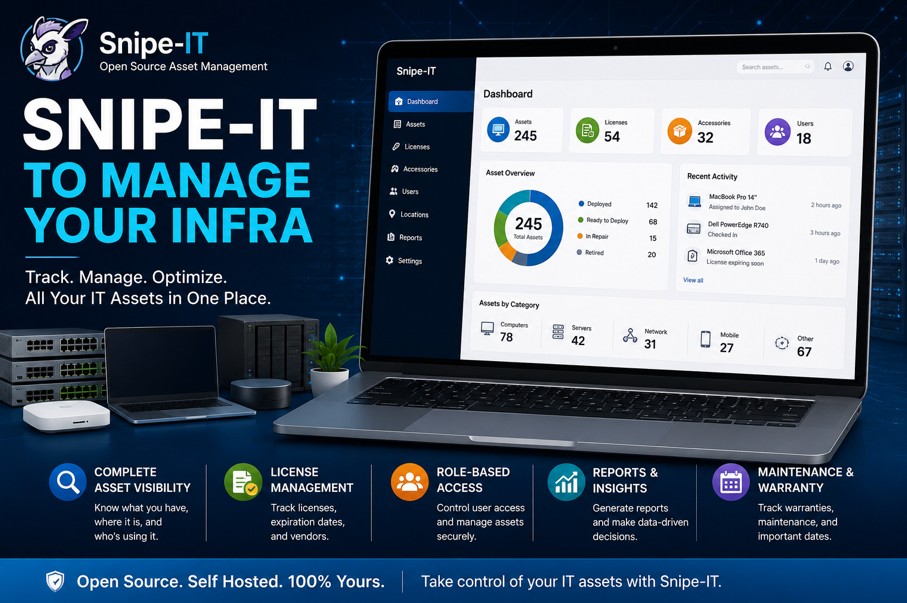
Open-source IT asset management made simple, powerful, and scalable.
Managing servers, laptops, desktops, software licenses, network equipment, and other IT assets can quickly become difficult when information is spread across spreadsheets and manual records.
This is where Snipe-IT can make a big difference.
What is Snipe-IT?
Snipe-IT is an open-source IT asset management (ITAM) platform designed to help organizations track and manage their technology assets from one centralized system.
You can use it to manage:
- Servers and virtual machines
- Laptops and desktops
- Network equipment
- Software licenses
- Accessories and peripherals
- Asset assignments
- Users and departments
- Maintenance information
- Warranty information
Because Snipe-IT can be self-hosted, organizations can maintain control over their asset-management data.
Why Use Snipe-IT?
1. Complete Asset Visibility
Know what hardware you have, where it is located, who is using it, and its current status.
Instead of maintaining multiple spreadsheets, your infrastructure information can be organized in one central platform.
2. Software License Management
Keep track of software licenses, purchase information, expiration dates, vendors, and assignments.
This can help IT teams avoid unnecessary purchases and reduce the risk of losing track of licenses.
3. User and Role Management
Snipe-IT provides user and permission management so organizations can control who can access and manage asset information.
4. Asset Assignments
Assign laptops, desktops, mobile devices, accessories, and other equipment to employees or locations.
When an employee changes department or leaves the organization, asset records can be updated accordingly.
5. Reports and Auditing
Centralized asset information makes it easier to generate reports and understand your infrastructure.
You can answer questions such as:
What assets do we own?
Who is using this laptop?
Which licenses are expiring?
Where is this server or device located?
Snipe-IT for DevOps and Infrastructure Teams
For DevOps, infrastructure, and system administration teams, Snipe-IT can complement monitoring and automation platforms.
For example:
Monitoring tools tell you whether a server is healthy.
Snipe-IT tells you what the server is, who owns it, where it is, and what other information is associated with that asset.
This creates a more complete infrastructure-management workflow.
You can maintain information about:
- Production servers
- Development servers
- Network devices
- Storage systems
- Firewalls
- Workstations
- Cloud-related assets
- Hardware ownership
- Maintenance schedules
Open Source and Self-Hosted
One of the major advantages of Snipe-IT is its open-source nature.
You can deploy it on your own infrastructure and maintain control over your data.
A typical self-hosted deployment could look like:
Internet / Internal Network
          │
          ▼
      Nginx
          │
          ▼
      PHP-FPM
          │
          ▼
       Snipe-IT
          │
          ▼
       MariaDB
You can also run Snipe-IT using containers, depending on your infrastructure and operational requirements.
Snipe-IT + Infrastructure Management
A useful infrastructure-management stack could be:
Snipe-IT
   │
   ├── Asset Management
   ├── License Management
   ├── User Management
   └── Hardware Inventory
          │
          ▼
Monitoring
   │
   ├── Prometheus
   ├── Grafana
   └── Alerting
          │
          ▼
Automation
   │
   ├── Ansible
   ├── Terraform
   └── CI/CD
Each tool has a different responsibility, creating a more organized IT environment.
Key Benefits
Snipe-IT can help you:
- Reduce spreadsheet-based asset tracking
- Improve infrastructure visibility
- Track hardware ownership
- Manage software licenses
- Improve asset accountability
- Track warranties and maintenance
- Centralize IT asset information
- Build a more organized IT operation
Getting Started
A simple implementation approach is:
- Deploy Snipe-IT on your server.
- Configure the database.
- Create administrators and users.
- Create asset categories.
- Add your hardware and software.
- Assign assets to users or locations.
- Import existing asset information.
- Establish a regular asset-audit process.
Start small and gradually bring your infrastructure inventory into the platform.
Final Thoughts
Infrastructure management is not only about servers, Kubernetes, networking, and monitoring.
Knowing what you own, where it is, who is using it, and how it is managed is equally important.
Snipe-IT provides a practical open-source solution for organizations that want better visibility and control over their IT assets without relying entirely on spreadsheets.
Manage your infrastructure smarter. Know your assets. Stay in control.
Tags: Snipe-IT IT Asset Management DevOps Infrastructure Management Open Source SysAdmin ITAM Asset Management Self Hosted Linux